- The Range
- Posts
- Fed Set For Final 2025 Rate Cut... But the Bond Market Isn’t Buying It
Fed Set For Final 2025 Rate Cut... But the Bond Market Isn’t Buying It
Here’s why investors should watch the 10-year yield more closely than the headlines as 2025 draws to a close.

👋Hello and Welcome to Monday! 🌅
Here’s what we’re watching this week:
It’s Fed week but longer-end rates don’t care: The 10-Yr yield is breaking higher ahead of what is expected to be another rate cut.
Earnings parade ahead: Oracle, Broadcom, Costco, Adobe, and GameStop headline the lineup.
Data dump incoming: trade deficit, jobless claims, and federal budget numbers roll out.
Let’s rock!🎸🎸🎸

💵What’s the market pricing in for the week ahead?
The Fed is closing out the year with one more blockbuster event: its final policy meeting of 2025. Markets are betting the central bank trims rates for a third straight meeting on Wednesday, pulling the target range down to 3.5%–3.75%. The big debate: should the Fed keep easing when inflation is still hanging out above its comfort zone?
Complicating things, policymakers are flying slightly blind. Thanks to lingering data delays from the government shutdown, they’ll be making this call without the latest jobs report—not ideal when labor-market worries are front and center and likely nudging the committee toward another cut.
After the decision, Chair Jerome Powell will step up to the mic for the usual press conference. Markets will be listening closely for clues about the Fed’s read on growth, hiring, and inflation—and how all of it shapes the playbook heading into the late-January meeting.
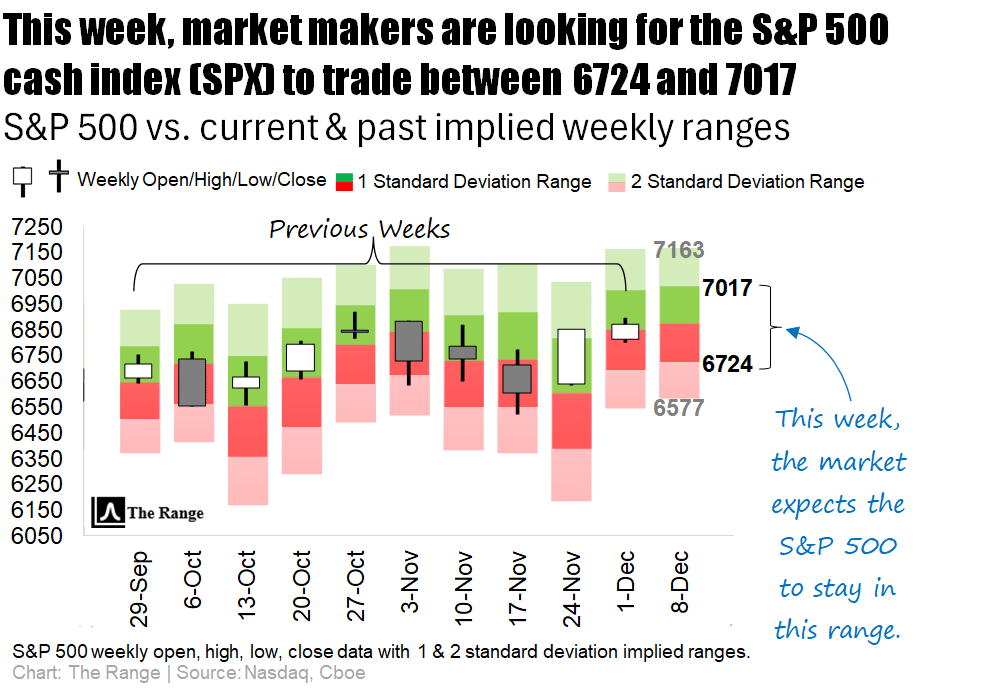
ℹ️ WHY IS THIS IMPORTANT?
For both stock and options traders: Knowing what the implied weekly range is helps set expectations for what the likely trading limits will be. This can help prevent overreaction near quantified range extremes, while also informing the traders on whether there is still room for an intra-week rally or sell-off to run.
📝 Note: This same logic can also be applied to the “Where’s the Action At?” section below.
Click here 👈 to learn more about our charts.

Tech, retail earnings take the stage
Corporate earnings are delivering their own drama this week, especially in the ever-crowded AI spotlight.
Oracle reports Wednesday after its stock got hammered in November over concerns it’s stretching its balance sheet to bankroll massive AI infrastructure investments. Also on deck: Broadcom, whose shares have been climbing on enthusiasm around its chip supply ties with Alphabet. Adobe will also share results midweek, giving investors another look at how AI-driven demand is filtering into its business despite recent stock pressure.
Retailers will round out the lineup. Costco reports Thursday and may offer fresh intel on tariff impacts—especially after the company announced a lawsuit against the Trump administration’s trade policies. AutoZone will update investors as well following a quarter where profits lagged expectations thanks to heavy spending on store growth.
🤔 Which companies are poised to possibly over- or underreact to earnings this week?
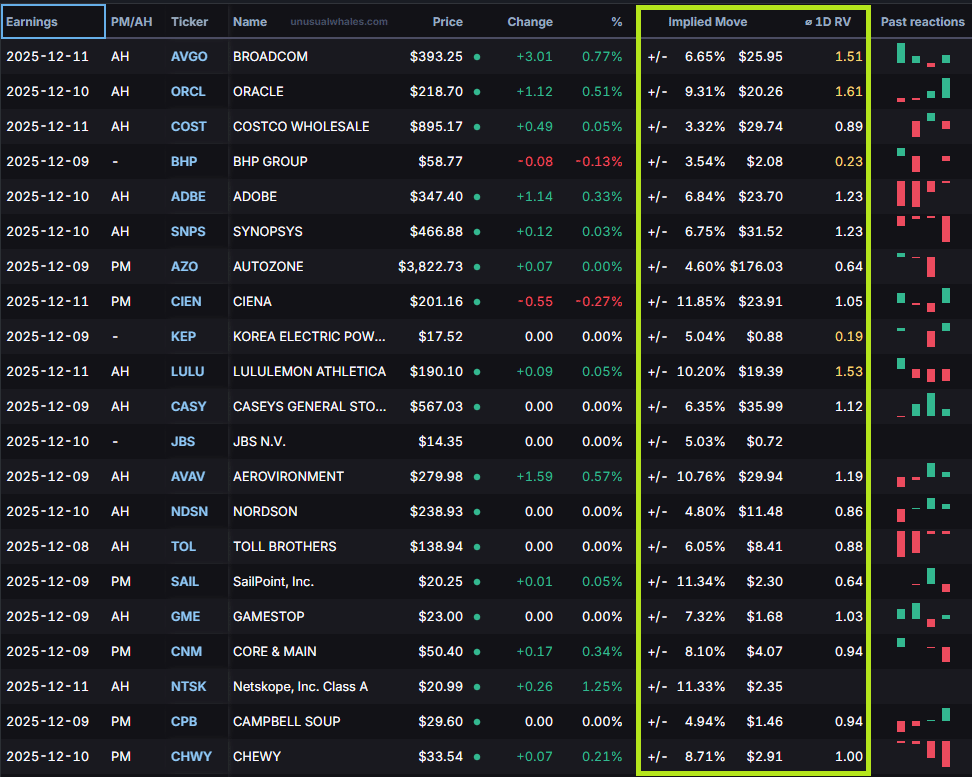
The largest company to report earnings this week, Broadcom, has shown a strong tendency to move outside of the market makers’ expected range during the trading session immediately following earnings (keep reading below the next table for more details on how this is calculated).
Of the 20 largest companies reporting earnings this week, Oracle, which is the second largest company reporting earnings, actually has a slightly greater tendency than Broadcom to overshoot the implied price range immediately following earnings.
On the other side of the coin, of the top 20 companies reporting this week, Autozone shows the greatest likelihood of staying inside its post-earnings expected ranges (keep reading below the next table for more details).
👇 Below is a look at this week’s biggest earnings reports, sorted by market cap:
HOW CAN TRADERS USE THIS INFORMATION?
For active traders looking for actionable insights, the highlighted columns on the table above show the implied (expected) post-earnings move for each company, along with the Average 1-Day Realized Volatility Post-Earnings Ratio (1D RV).
📈Implied Move: The market’s best guess at how much a stock will swing after earnings.
📊1D RV: A powerful tool that represents the post-earnings price move divided by the expected price move over the past 12 quarters. In other words, it measures how good (or bad) the market is at pricing each company’s earnings.
💵When you see a ratio >1.0, it indicates that, historically, the earnings are mispriced and the stock moves MORE than the market anticipates, favoring straddle buyers.
🪝A ratio <1.0 tells the opposite story, meaning the stock historically moves LESS than the market anticipates, which favors straddle sellers.
Happy hunting.

The bond market is sending a message—and it’s way louder than Washington’s rate-cut chatter.
Despite months of political pressure on the Fed (including President Trump’s pledge to “do everything possible” to push borrowing costs lower) and traders broadly expecting another rate cut this December, long-term Treasury yields aren’t playing along.
Instead of drifting lower, the long end has been stuck in a massive sideways range—more like a breather in the post-2020 bond sell-off than a pivot toward cheaper long-term borrowing.
Short end vs. long end: two different universes
The short-end moves when the Fed talks. The long end moves when long-horizon investors—pensions, insurers, global funds—buy into the macro story. And right now, they’re not convinced.
This matters because bond markets price structural reality, while equity markets, especially in recent years, mostly follow momentum and narratives. When stocks cheer potential cuts but long-end yields climb anyway, the bond market is effectively saying, “Good luck with that.”
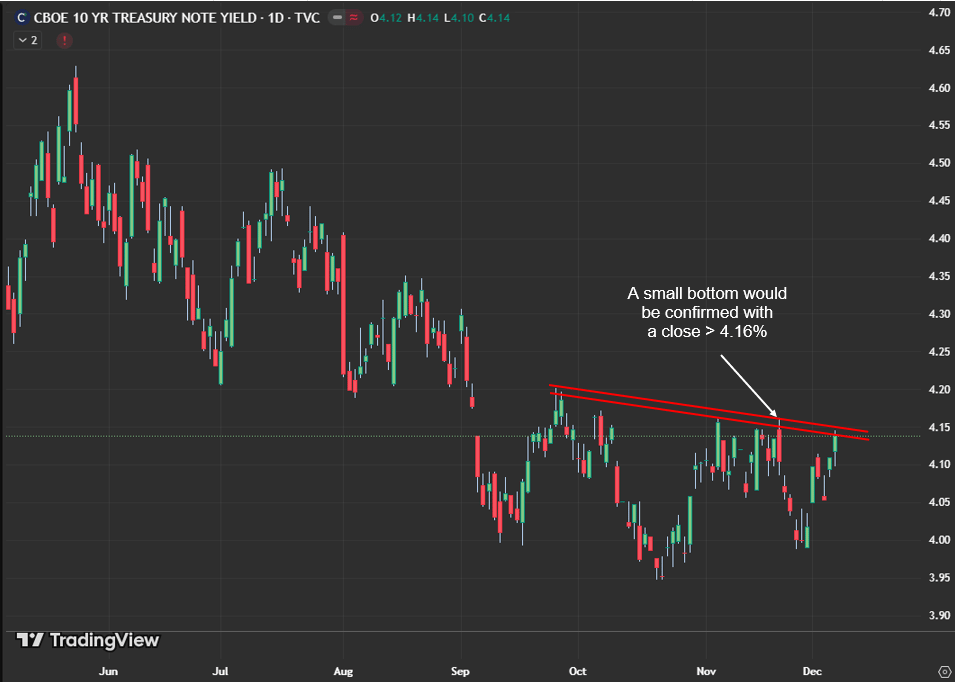
Heading into the final Fed week of 2025, the 10-year yield is lifting off a three-month low. If it closes above 4.16%, it will confirm an intermediate-term bottom in the benchmark rate.
But a critical observation from recent years is that rising long-term interest rates alone don’t necessarily cause material deterioration in the S&P 500.
Instead, the rate of change (i.e., the speed of the rate rise) must be aggressive and sustained (typically for at least a couple of months) in order for the stock market to come under meaningful pressure.
As of right now, there’s still a lot of ground to cover before rates reach meaningful upside escape velocity.
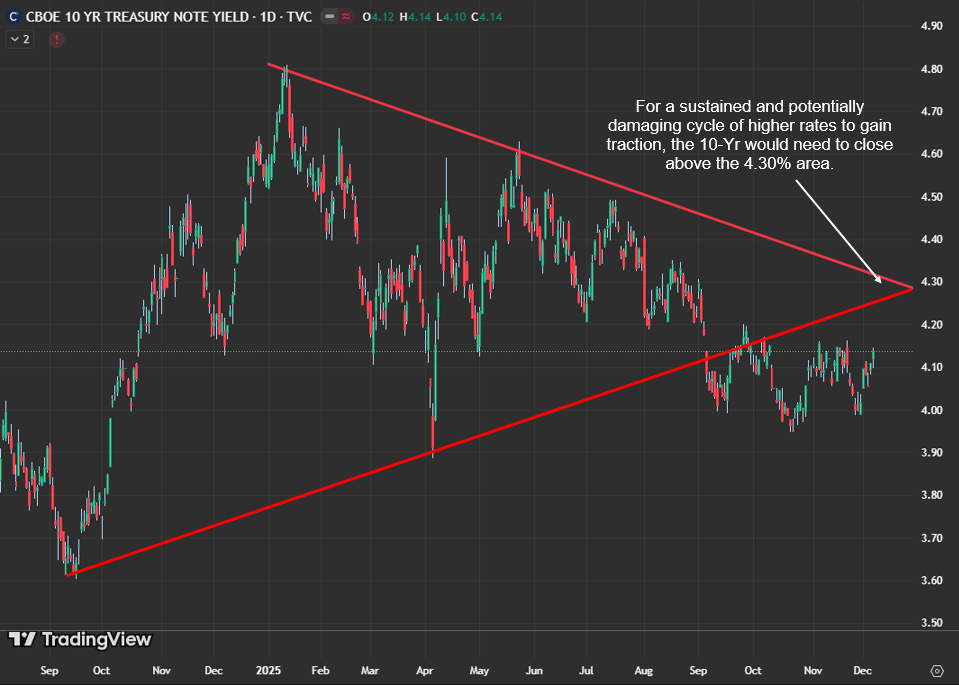
Specifically, don’t start to panic about the rise in rates getting out of control until the 10-Yr closes above roughly 4.3%.

✈️ Fine against Southwest Airlines for 2022 winter storm cancellations waived by Department of Transportation: The DOT wiped away the last $11 million of Southwest’s meltdown penalty like a teacher forgiving late homework, crediting the airline for finally getting its act together. Read more
💵 The consumer is "fine" but inflation is "not going down," Dimon says: Jamie Dimon says Americans are holding up surprisingly well even as inflation clings on like a houseguest who refuses to leave. Read more
🚗 US says new fuel economy rule could lead to return of station wagons: New fuel-economy rules may resurrect the legendary family station wagon, giving automakers room to bring back the long-roof classics nobody expected a sequel to. Read more

Giphy
🔥 Combustible portable chargers recalled after causing injuries and property damage: Over 200,000 INIU power banks are being recalled after several decided to overheat, spark, and channel their inner dragon, causing burns and small fires. Read more
🤖 OpenAI’s GPT-5.2 ‘code red’ response to Google is coming next week: OpenAI is reportedly rushing GPT-5.2 out the door like someone trying to clean their apartment before guests arrive, hoping to fend off Google’s growing AI heat. Read more

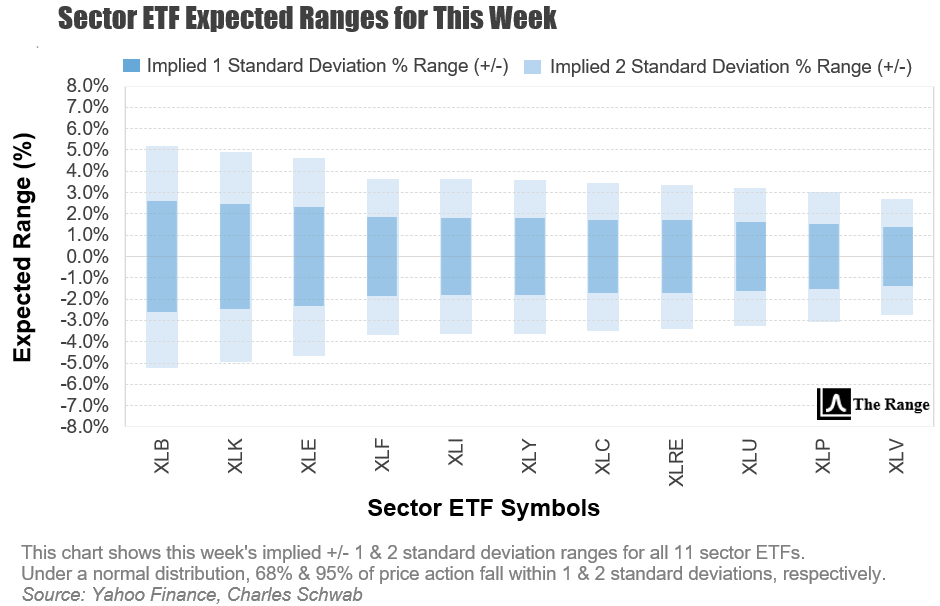
For the first time in several weeks, technology is no longer the sector that is expected to move the most over the next five trading sessions. That outlook is now with basic materials (XLB). Technology (XLK) is now expected to host the second largest weekly movement, followed closely by the energy (XLE) sector.
Conversely, the utilities (XLU), consumer staples (XLP), and healthcare (XLV) are all showing the lowest implied volatility/expected movement over the week ahead.
ℹ️ WHY IS THIS IMPORTANT?
For options traders in particular: Implied volatility sets the tone for option prices. Understanding where large or small implied moves are priced in helps traders decide whether options are over- or under-valued before placing trades.

Monday
Key Earnings: Toll Brothers, Phreesia
Tuesday
Job openings
More Data to Watch: NFIB small business optimism
Key Earnings: AutoZone, Toll Brothers, Ferguson Enterprises, Casey’s General Stores, AeroVironment, GameStop, SailPoint, Core & Main, Campbell’s
Wednesday
Federal Open Market Committee interest rate decision
Fed Chair Jerome Powell press conference
More Data to Watch: Employment cost index, monthly U.S. federal budget
Key Earnings: Oracle, Adobe, Synopsys, Chewy, Nordson
Thursday
U.S. trade deficit
More Data to Watch: Initial jobless claims, Wholesale inventories
Key Earnings: Broadcom, Costco, Ciena, Lululemon, Netskope
Friday
Federal Reserve Official Speaking: Chicago Fed President Austan Goolsbee
Key Earnings: Johnson Outdoors, Value Line

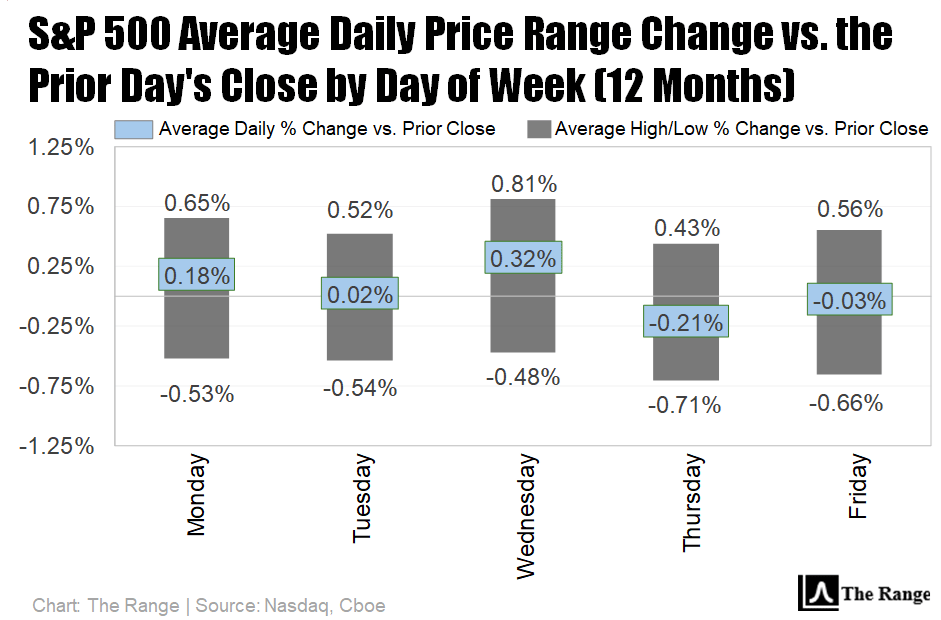
For the most part, the S&P 500 didn’t veer too far away from its daily norms of the past 12 months this past week.
While the VIX’s current position back down near the bottom of its one-year range implies that volatility should remain near the daily norms again this week, we must reinforce that the potential for a reflexive increase in volatility this week, given the extreme decline in the VIX in recent weeks, can’t be ruled out.
📝 EDITOR’S NOTE
Each day the market is open, we update our comprehensive performance charts on our website for you to view. In addition, be sure to follow us on X for timely intra-week updates.

📋Here’s a curated list of top value-added insights that uncover what’s happening way beyond the usual financial media headlines.

Please be sure to follow us on X.
If you like what we're doing, please forward us to a friend. If you're not already subscribed, join our growing family of free subscribers.
Reply