- The Range
- Posts
- A Short Week, Long on Risk
A Short Week, Long on Risk
Trump's fresh tariff talk rattles futures as Davos opens and a key S&P level comes into focus.

👋Hello and welcome to a new trading week! 🌅
Here’s what we’re watching during this holiday-shortened week:
Short trading week, but packed with inflation data, Davos headlines, key earnings, and spiking volatility.
Tariff escalation shocks markets, amplifying seasonal volatility and threatening a near-term S&P trend reversal.
Trump’s upcoming Davos speech puts housing reform and Fed tensions squarely in focus.
Netflix, Intel, airlines, and industrials headline a market-moving earnings slate.
Let’s dive in. 💦💦💦

💵What’s the market pricing in for the week ahead?
It’s a short week, but with a big agenda. Markets took Monday off for Martin Luther King Jr. Day, but Wall Street doesn’t get much of a breather after that as Davos is in full swing and earnings season keeps rolling.
The World Economic Forum opens in Switzerland just as investors digest delayed U.S. economic data, including October and November PCE inflation and the final read on Q3 GDP.
After his announcement in a Truth Social post that eight NATO members’ U.S. imports will face escalating tariffs sent stock futures tumbling overnight, President Trump is set to speak Wednesday, with housing affordability expected to be front and center—alongside proposals targeting institutional homebuyers and mortgage-market intervention.
Meanwhile, policymakers are watching inflation closely ahead of next week’s Fed meeting, even as the Supreme Court hears arguments tied to Trump’s effort to remove Fed Governor Lisa Cook.

ℹ️ WHY IS THIS IMPORTANT?
Knowing what the implied weekly range is helps traders set expectations for what the likely trading limits will be. This can help prevent overreaction near quantified range extremes, while also providing perspective on whether there is still room for an intra-week rally or sell-off to run.
📝 Note: This same logic can also be applied to the “Where’s the Action At?” section below.
Click here 👈 to learn more about our charts.

📈It’s a tech-and-transportation-heavy earnings slate this week
Netflix and Intel headline the week, with Netflix’s results potentially shedding light on a possible Warner Bros. Discovery deal, and Intel riding optimism around its AI PC chips and fresh investment support.
Airlines and industrials also step into the spotlight, with United, GE Aerospace, 3M, Travelers, and Johnson & Johnson all reporting as investors gauge demand, margins, and guidance across the economy.
🤔 Which companies are poised to possibly over- or underreact to earnings this week?
The largest company to report earnings this week, Johnson & Johnson, has a history of trading very close to the market makers’ expected range during the trading session immediately following earnings (keep reading below the next table for more details on how this is calculated).
Of the 20 largest companies reporting earnings this week, 3M has the strongest tendency to overshoot the implied price range immediately following earnings.
On the other side of the coin, of the top 20 companies reporting this week, ICICI Bank shows the greatest likelihood of staying inside its post-earnings expected range (keep reading below the next table for more details).
👇 Below is a look at this week’s biggest earnings reports, sorted by market cap:

HOW CAN TRADERS USE THIS INFORMATION?
For active traders looking to trade some of this week’s earnings plays, the highlighted columns on the table above show the implied (expected) post-earnings move for each company, along with the Average 1-Day Realized Volatility Post-Earnings Ratio (1D RV).
📈Implied Move: The market’s best guess at how much a stock will swing after earnings.
📊1D RV: A powerful tool that represents the post-earnings price move divided by the expected price move over the past 12 quarters. In other words, it measures how good (or bad) the market is at pricing each company’s earnings.
💵When you see a ratio >1.0, it indicates that, historically, the earnings are mispriced and the stock moves MORE than the market anticipates, favoring straddle buyers.
🪝A ratio <1.0 tells the opposite story, meaning the stock historically moves LESS than the market anticipates, which favors straddle sellers.
Happy hunting.

📉Bond sell-off in Japan triggers U.S. Treasuries to join Global Bond Slide: Concern around Japan’s fiscal outlook sent yields on the nation’s 40-year debt rocketing above 4% in the Asian session, the most on record. That’s weighing on long-dated debt around the world. Read more
⚖️ Fed Chair Jerome Powell is set to attend Supreme Court arguments tied to Trump’s effort to fire Governor Lisa Cook: Federal Reserve Chair Jerome Powell plans to show up at the Supreme Court as justices consider whether President Trump can fire Fed governor Lisa Cook, a rare public stance from the normally apolitical central banker and a big moment for central bank independence. Read more
🔗 NYSE to launch 24/7 blockchain-powered tokenized stock and ETF trading: The New York Stock Exchange’s parent Intercontinental Exchange is developing a blockchain-based trading platform to allow tokenized stocks and ETFs to trade around the clock with instant settlement and stablecoin funding, pending regulatory approval. Read more

Giphy
🌐 Second Sphere venue planned for Maryland’s National Harbor: Sphere Entertainment and Maryland officials announced plans to build a 6,000-seat “mini-Sphere” at National Harbor near Washington, D.C., using about $200 million in public and private funding and expected to generate significant jobs and economic activity. Read more
📈 China says economy grew 5% in 2025 despite slowing consumer demand and deep demographic challenges: China reported 5% growth last year, hitting its official target mostly thanks to a record trade surplus and strong exports even as domestic spending, investment, the property market and births lagged, leaving economists to warn of a “two-speed” economy that still depends heavily on external demand. Read more

Markets set to absorb another Oval Office jab
In a Truth Social post on Saturday, President Trump announced that imports from eight NATO members will face escalating U.S. tariffs “until such time as a Deal is reached for the Complete and Total purchase of Greenland.” The tariffs are set to start at 10% on Feb. 1 and climb to 25% by June 1, according to Trump. European leaders were quick to call the move “unacceptable.”
Markets are taking note. U.S. equity index futures are sharply lower this morning, piling pressure onto an S&P 500 that has already entered a historically choppy stretch of the calendar.
That weakness—highlighted by the red arrow in the chart below—began right on the eighth trading day of the month, a timing that lines up neatly with seasonal patterns. If the S&P 500 cash index (SPX) fails to close above 6,858.56 at any point this week, it would trigger a technical shift strong enough to flip the index’s previously bullish trend, increasing the odds that January’s back half follows its usual script of underperformance.

EDITOR’S NOTE: Market Rhymes is our premium service hosted on Substack at https://marketrhymes.substack.com/. Market Rhymes will remain free for the next several months as we continue to build out the framework and earn the trust of our readers. Even when premium content is put behind a paywall, we’ll continue to post a ton of free content via Substack “Notes.” Please join us on this journey at https://marketrhymes.substack.com/ .

This week, the energy (XLE) sector is expected to be the most volatility sector, with technology (XLK) and consumer cyclicals sectors registering the next highest levels of implied volatility.
Conversely, the health care (XLV), consumer staples (XLP), and real estate (XLRE) sectors are expected to have the lowest volatility.
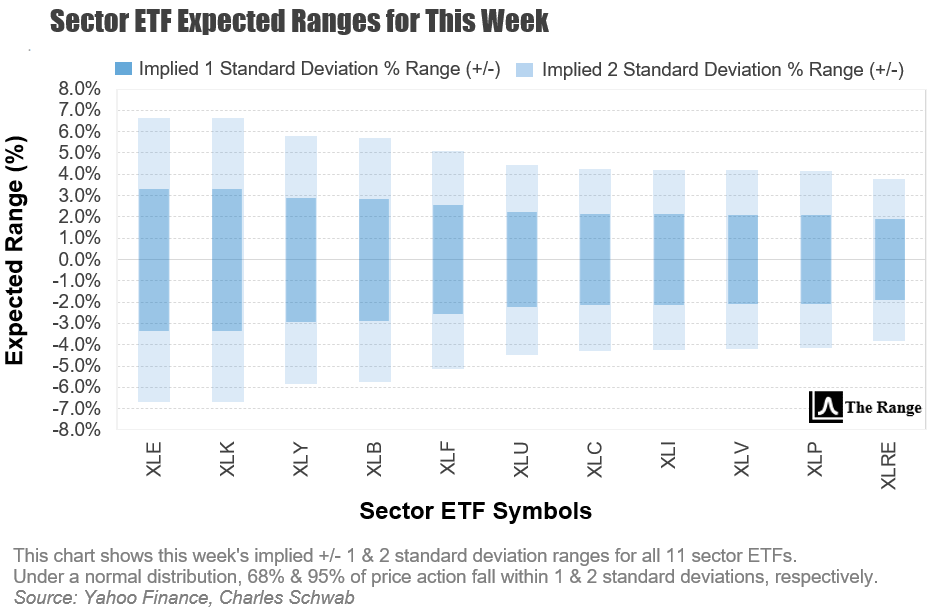
ℹ️ WHY IS THIS IMPORTANT?
For options traders in particular: Implied volatility sets the tone for option prices. Understanding where large or small implied moves are priced in helps traders decide whether options are over- or under-valued before placing trades.

Tuesday
Top Earnings: Netflix, 3M, U.S. Bancorp, Fastenal, D.R. Horton, United Airlines, Fifth Third Bancorp, Interactive Brokers
Wednesday
President Trump delivers remarks at the Davos World Economic Forum
Supreme Court oral arguments in Fed Governor Lisa Cook case
Construction spending, Pending home sales
Top Earnings: Johnson & Johnson, Charles Schwab, Truist Financial, Travelers Companies, Halliburton, Citizens Financial Group
Thursday
Personal Consumption Expenditures (PCE) price index
Gross domestic product - final reading (Q3), Initial jobless claims
Top Earnings: GE Aerospace, Procter & Gamble, Abbott Laboratories, Intel, Intuitive Surgical, Capital One Financial, CSX
Friday
WEF in Davos concludes
Consumer sentiment - final
S&P flash U.S. PMI
Top Earnings: Ericsson, First Citizen, Booz Allen Hamilton

The sharp drop in volatility that followed the Supreme Court’s paused tariff decision on Jan. 9 proved fleeting, with the Cboe Volatility Index (VIX) rebounding to fresh multi-week highs last week.
Aside from Wednesday’s session, the S&P 500 spent most of last week trading within its typical daily ranges. But the VIX’s persistent climb has been a tell: investors have been quietly adding protection even as stocks sit near all-time highs.
Now, with volatility pushing above long-term averages following this weekend’s tariff escalation, the odds are rising that the S&P 500 breaks outside its normal daily ranges in the days ahead.

📝 EDITOR’S NOTE
Each day the market is open, we update our comprehensive performance charts on our website for you to view. In addition, be sure to follow us on X for timely intra-week updates.

📋Here’s a curated list of top value-added insights that uncover what’s happening way beyond the usual financial media headlines.

Please be sure to follow us on X.
If you like what we're doing, please forward us to a friend. If you're not already subscribed, join our growing family of free subscribers.
Reply